

How does the new generation of delivery systems enhance the stability of skincare ingredients?

Highly active skincare ingredients such as retinol, pure vitamin C and polyphenols are generally unstable when exposed to light, oxygen and heat, and are highly prone to oxidation and degradation. This leads to the product losing its potency within a short period, a significant drop in efficacy, and skin irritation and redness. Conventional skincare products rely on antioxidants, chelating agents and light-protective packaging to merely delay degradation, rather than locking in activity at its source. In contrast, the new generation of molecular delivery systems utilises physical encapsulation, structural optimisation and precise controlled release to comprehensively resolve the issue of ingredient inactivation, whilst simultaneously ensuring formulation stability, transdermal efficiency and gentle application.
Taking 0.3% free retinol as an example, in unencapsulated traditional formulations, activity typically declines by 30%–50% following standard warehousing and 12 months on the shelf. Under extreme storage and transport conditions, residual activity may even fall below 0.15%, rendering the product virtually ineffective.
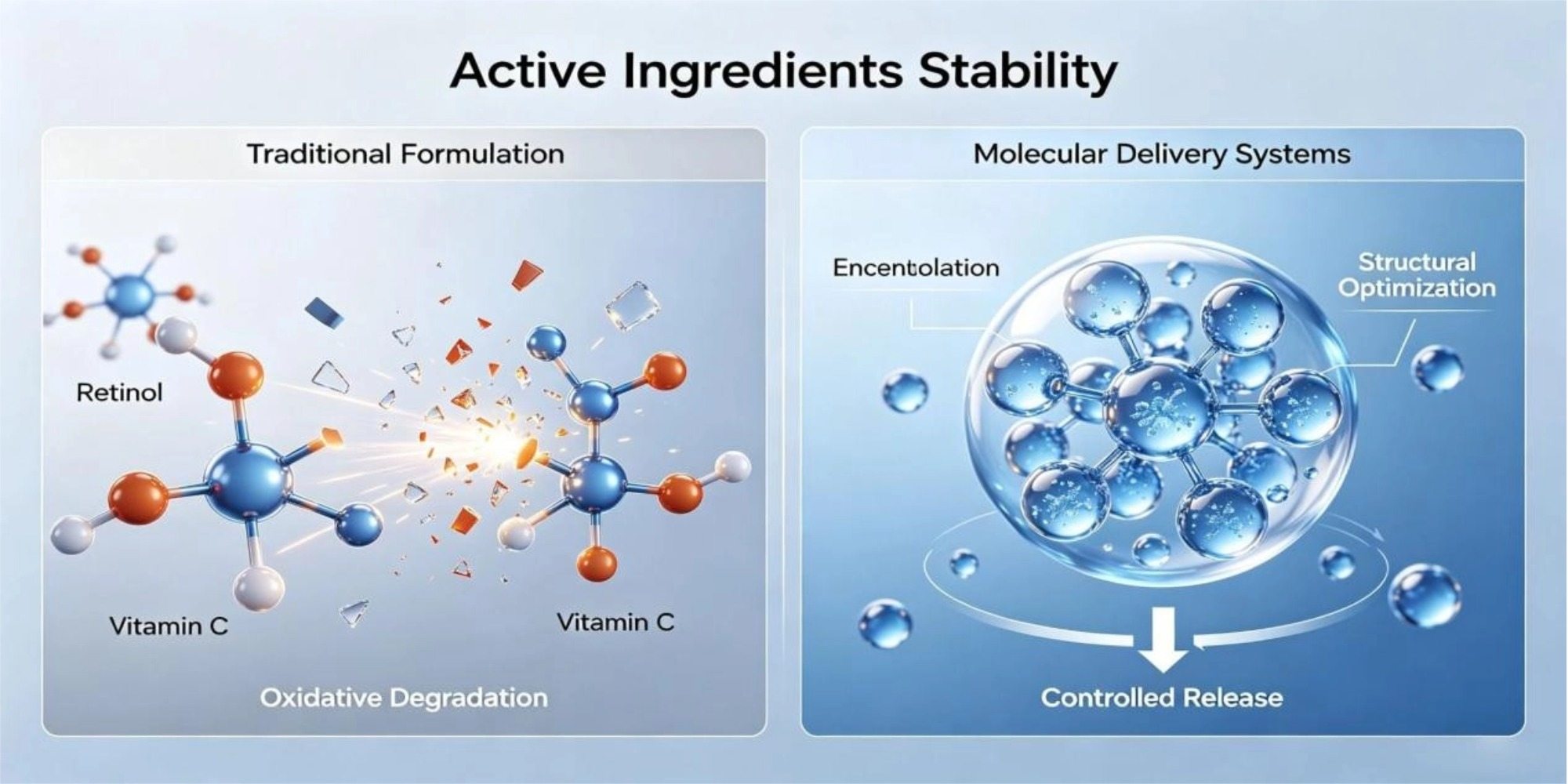
This new-generation delivery system ‘locks in’ active ingredients at a molecular level, ensuring shelf stability and precise release onto the skin.
1. Liposome encapsulation: Biocompatible protection that is both effective and gentle
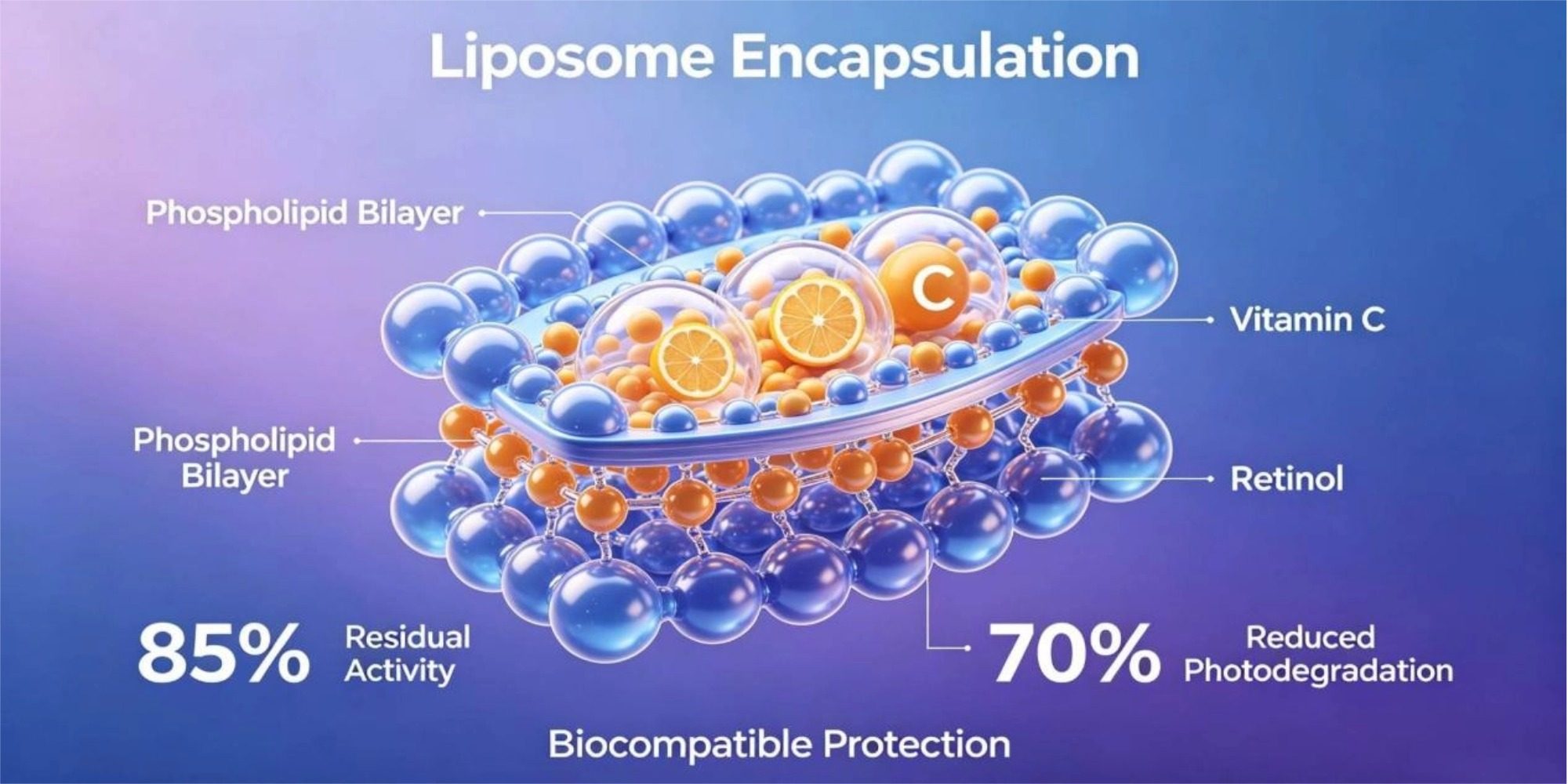
Liposomes, based on a phospholipid bilayer structure, are highly homologous to skin cell membranes and exhibit excellent biocompatibility. They can encapsulate active ingredients in a compartmentalised manner: water-soluble vitamin C is encapsulated within the internal aqueous phase, whilst fat-soluble retinol is embedded within the membrane layers, forming a physical protective barrier that shields against damage from light, oxygen and heat.
According to in vitro experimental data published in the *International Journal of Pharmaceutics* in 2024, following liposome encapsulation, the residual activity of vitamin C after six weeks of storage at 40°C increased from less than 30% to over 85%, the photodegradation rate of retinol was reduced by 70%, transdermal efficiency doubled, and irritation was significantly reduced (data based on laboratory tests using pure systems; results may vary slightly in commercial products).
Comparison of key advantages: After three months of storage at room temperature, traditional unencapsulated formulations retain only 20%–50% of their activity, whereas the liposome formulation maintains 80%–95% activity. It simultaneously addresses the issues of traditional formulations—where ingredients remain confined to the epidermis, absorption rates are low, and highly active ingredients are prone to causing irritation—achieving a triple balance of stability, efficacy and gentleness.
2. Nanoemulsions & NLC nano-lipid carriers: improved particle size, sustained-release formulation
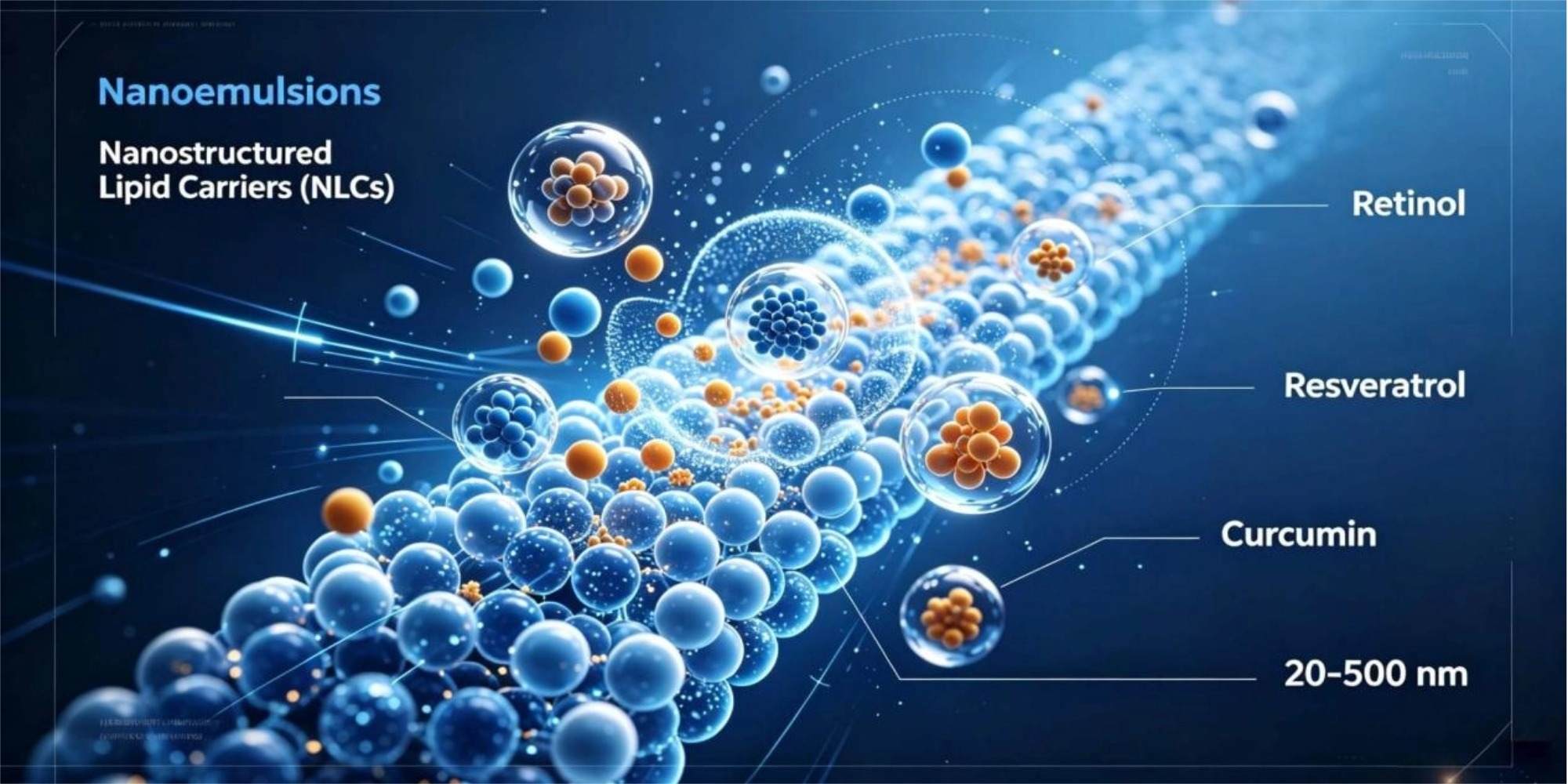
Nanoemulsions and nanostructured lipid carriers (NLCs) represent an advanced iteration of lipid delivery technology, suitable for poorly soluble, easily degradable and highly irritating ingredients such as retinol, resveratrol and curcumin. With particle sizes ranging from 20 to 500 nm, the Brownian motion of these extremely small droplets prevents phase separation and sedimentation, effectively dispersing poorly soluble ingredients and resolving issues of precipitation and inactivation; the only minor stability limitation arises under prolonged exposure to extreme high temperatures.
NLCs represent an upgraded version of solid lipid nanoparticles. By utilising solid-liquid mixed lipids to construct a lattice defect structure, they offer higher drug-loading capacity, greater system stability and enhanced sustained-release properties. A 2024 study published in the *International Journal of Molecular Sciences* confirmed that NLCs loaded with retinol and oligopeptides maintained stable particle size and showed no agglomeration or separation after four weeks of storage at 25°C (though reasonable variations in particle size may occur in mass-produced formulations).
Compared to traditional emulsions, NLCs are significantly superior in terms of physical stability, ingredient protection and controlled-release performance. They enable the uniform release of active ingredients such as retinol, avoiding the ‘shock’ of instantaneous high concentrations on the skin, thereby reducing issues of intolerance such as redness and stinging at the source.
3. Cyclodextrin inclusion complexes: molecular cage encapsulation for solubilisation and stabilisation
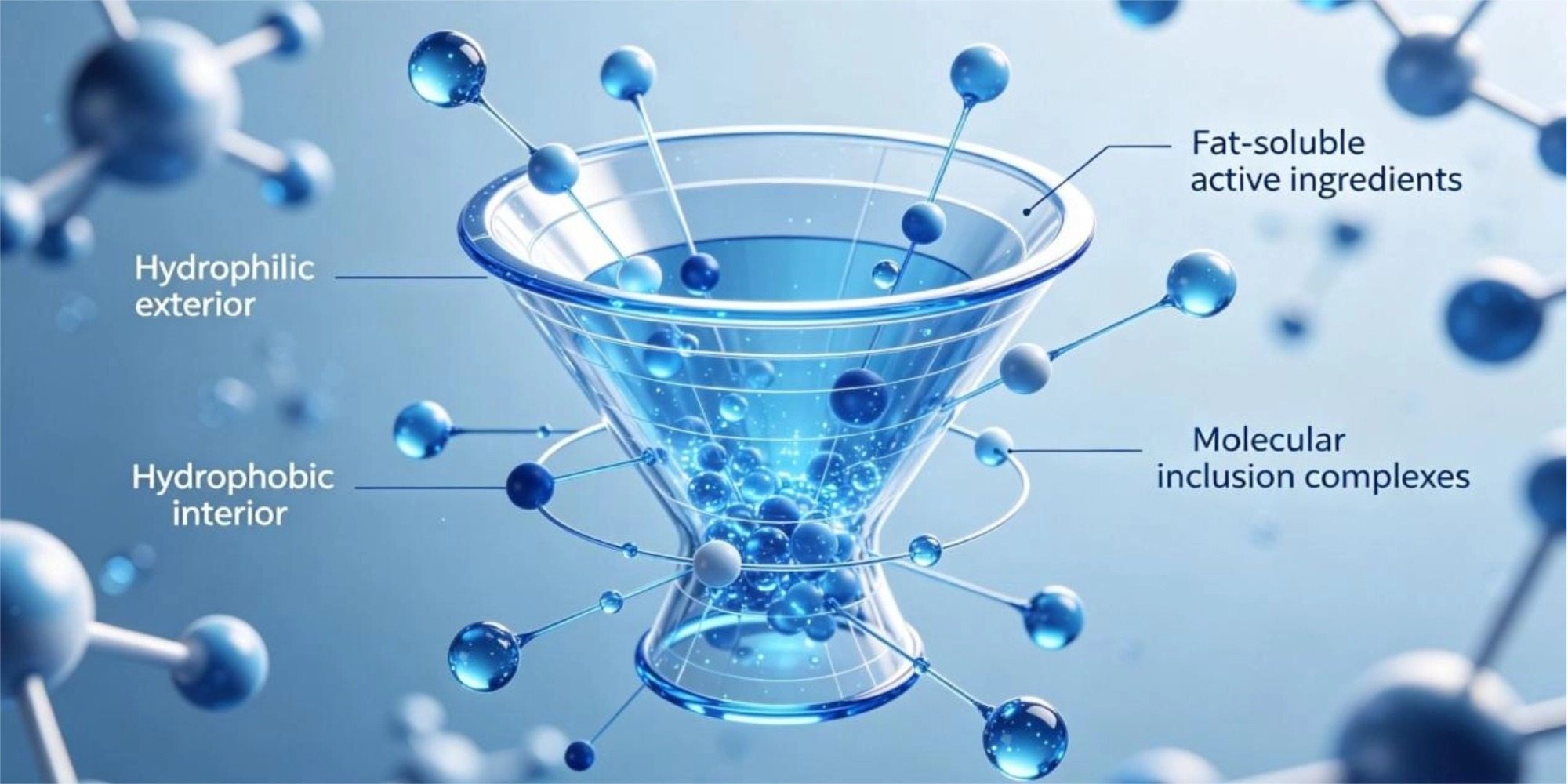
Cyclodextrin is a hollow, funnel-shaped natural polysaccharide with hydrophilic exterior and hydrophobic interior properties. It can incorporate polyphenols and fat-soluble active ingredients into its cavity via non-covalent bonds, forming stable molecular inclusion complexes. This not only shields the active ingredients from external environmental interference, significantly enhancing their light and heat stability and inhibiting degradation, but also increases the water solubility of hydrophobic components by tens to hundreds of times, thereby addressing the challenges of poor solubility, low bioavailability and susceptibility to precipitation.
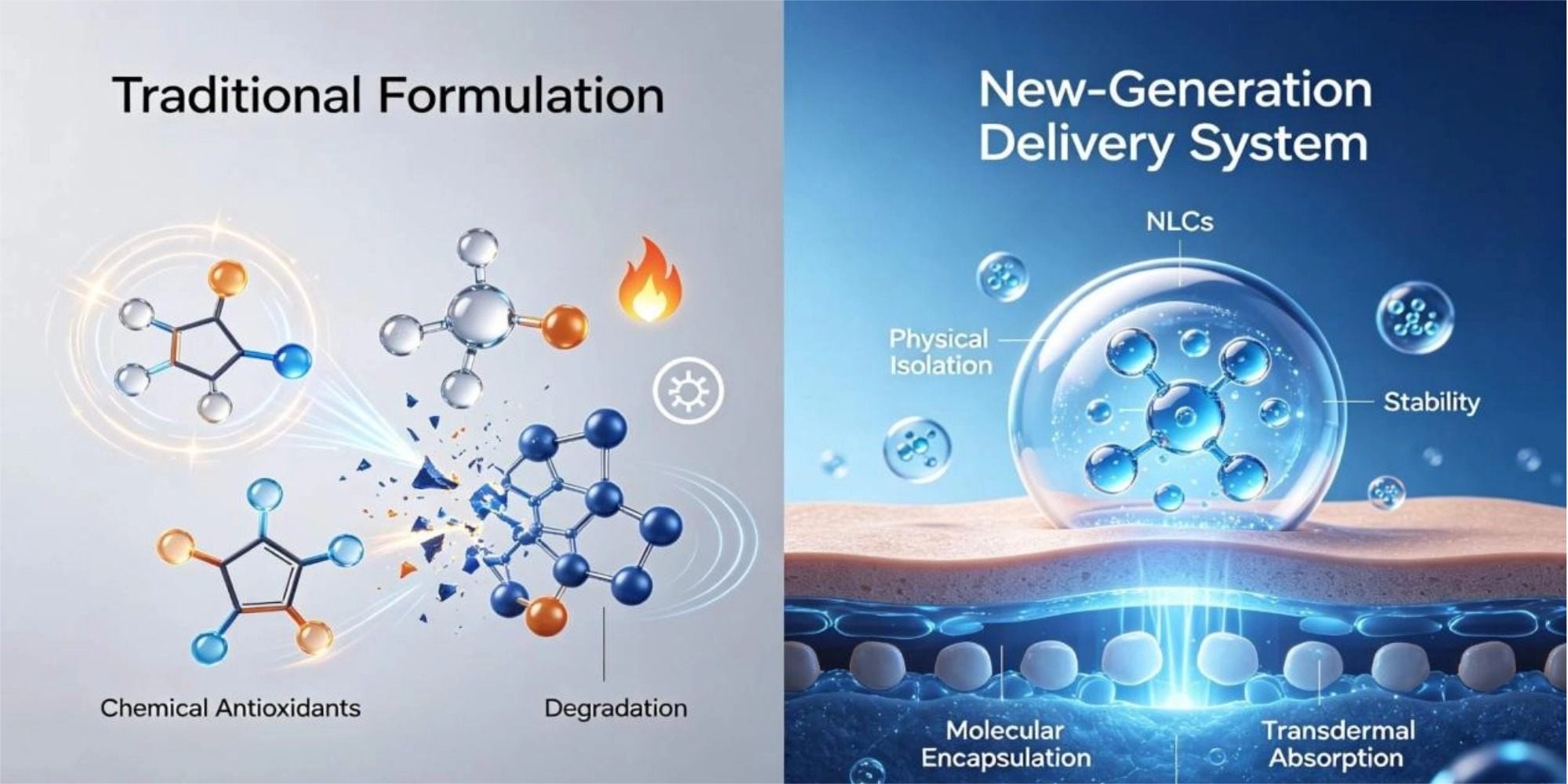
4. Key differences between the old and new technologies: slowing down degradation vs. blocking degradation
Traditional formulations rely on chemical antioxidants to delay ingredient degradation, but fail to address the root cause of degradation; as a result, ingredients continue to degrade and their efficacy diminishes rapidly. The new-generation delivery system employs a combination of physical isolation and molecular encapsulation, which preserves the chemical structure of the active ingredients, minimises the risk of degradation at source, significantly enhances transdermal absorption, and ensures both long-term stability of active ingredients and sustained skincare efficacy throughout the shelf life.
5. Cutting-edge breakthroughs and commercial implementation: High-end delivery technology becomes mainstream
With the evolution of skincare delivery technologies, the industry has moved from traditional empirical formulations to a phase of precision molecular design. In May 2026, Amorepacific’s Lipo3Ex20nm ultra-fine liposome technology, developed in collaboration with KAIST, was featured on the cover of *ACS Nano*. This breakthrough overcame the industry-wide challenge that ‘the smaller the nanoscale, the less stable the structure’, significantly enhancing delivery efficiency. The technology has already been successfully implemented in mass production for the IOPE and Primera brands, signifying that ultra-fine nanocarrier technology has officially reached commercial maturity.
For a long time, high-end liposome, NLC and cyclodextrin delivery technologies have been monopolised by major international brands due to high R&D barriers and high mass production costs. Through its established OEM/ODM system, Guangzhou Aisen Biotechnology has modularised and standardised these three high-end delivery technologies, breaking down the barriers of technological premium pricing. This enables small and medium-sized brands to flexibly select mature carrier solutions and support small-batch production, with scaled-up costs approaching those of traditional formulations, thereby making high-end technology accessible to the masses. The application logic for these three technologies is as follows: Liposomes serve as a universal, highly compatible solution, suitable for water-soluble ingredients such as vitamin C, peptides and panthenol, and are ideal for repair, antioxidant and basic anti-ageing formulations; NLC nano-lipid carriers specialise in highly active yet gentle anti-ageing, suitable for lipophilic, potentially irritating ingredients such as retinol and curcumin, reducing skin intolerance through controlled-release mechanisms; Cyclodextrin complexes focus on improving plant extracts and hydrophobic ingredients, addressing the issues of poor solubility, precipitation and oxidation in polyphenols and essential oils; they are suitable for plant-based antioxidant and soothing formulations, and can be precisely selected and implemented according to a brand’s specific efficacy requirements.
Related products
Microencapsulated Retinol Serum – gentle time-release anti-aging