

How to choose anti-ageing retinol ingredients? From retinol, retinaldehyde, HPR to psoralen—everything you need to know in one article

‘Vitamin C in the morning, Vitamin A in the evening’ is a classic anti-ageing skincare routine that is widely recognised globally; however, many consumers and beauty professionals find it difficult to distinguish between the main Vitamin A ingredients: retinol, retinaldehyde, HPR and psoralen. These four ingredients differ significantly in terms of their mechanisms of action, gentleness and formulation challenges. The following section provides an objective analysis based on skin physiology, accompanied by formulation recommendations from Aisen.
Vitamin A Metabolism Pathway: The Metabolic Pathway Influences Efficacy and Irritation
The key active ingredient responsible for its effects on the skin is retinoic acid, a prescription-only medical ingredient that is highly irritating; as such, regulations in various countries prohibit its inclusion in general skincare products. All vitamin A ingredients available on the market are precursors to retinoic acid and must undergo enzymatic conversion within the skin to become active. The conversion pathway is as follows: retinol esters → retinol → retinaldehyde → retinoic acid. As a general rule: the more conversion steps involved, the lower the risk of irritation, but the theoretical upper limit of efficacy at the same concentration is lower; the fewer conversion steps, the higher the theoretical anti-ageing potential, whilst the likelihood of irritation increases accordingly. Ultimately, the user experience is determined by the formulation’s delivery technology.
1. Retinol (Retinol A): The classic entry-level form of vitamin A
It requires a two-step oxidation process to convert into retinoic acid before it becomes effective; there is ample clinical research on this, and it is widely used in the market. Drawbacks: It is prone to oxidation and inactivation when exposed to light, oxygen or high temperatures, and may cause dryness, redness and flaking in first-time users. Suitable for: those with a healthy skin barrier and good tolerance, and those trying retinol for the first time.
2. Retinaldehyde: An Advanced, Highly Effective Anti-Ageing Ingredient
It becomes active after just a single oxidation step, and at equivalent concentrations, its bioavailability is significantly higher than that of retinol. Visible improvements in fine lines, dullness and enlarged pores can be observed after 6 weeks of continuous use at low concentrations. Drawbacks: It is sensitive to light and oxygen; without a sustained-release formulation, it may irritate the skin, and it requires sophisticated manufacturing processes. Suitable for: Those with healthy skin who have been using vitamin A long-term and are seeking rapid anti-ageing results.
3. HPR (hydroxypinacolone retinoate): a low-irritation vitamin A derivative
It binds directly to the skin's vitamin A receptors without the need for conversion. It is exceptionally stable, retaining over 90% of its activity after 12 weeks of storage at 40°C under light, and is far less irritating than traditional vitamin A. Drawback: its fat-soluble nature results in relatively poor transdermal absorption, so it requires the use of delivery technologies to enhance bioavailability. Suitable for: sensitive skin and those with vitamin A intolerance. For brands targeting the sensitive-skin anti-aging segment, a peptide-based alternative such as a Copper Peptide Repair Serum offers a complementary route—supporting collagen production and barrier repair without any vitamin A-related irritation.
4. Psoralen: A gentle, plant-based alternative for anti-ageing
Extracted from Psoralea corylifolia seeds, its structure differs from that of retinol, yet it can regulate genes associated with anti-ageing. A controlled trial published in the British Journal of Dermatology showed that, after 12 weeks of use, there was no significant difference in wrinkle reduction or skin brightening between 0.5% psoralen and 0.5% retinol; the psoralen group demonstrated better tolerability and no photosensitivity, making it suitable for daytime use. Suitable for: those with sensitive skin, those who prefer natural ingredients, and those seeking daytime anti-ageing care. Aisen's Bakuchiol + Peptide Firming Serum is built on this logic, delivering retinol-comparable firming without irritation, making it ideal for clean beauty and pregnancy-safe skincare lines.
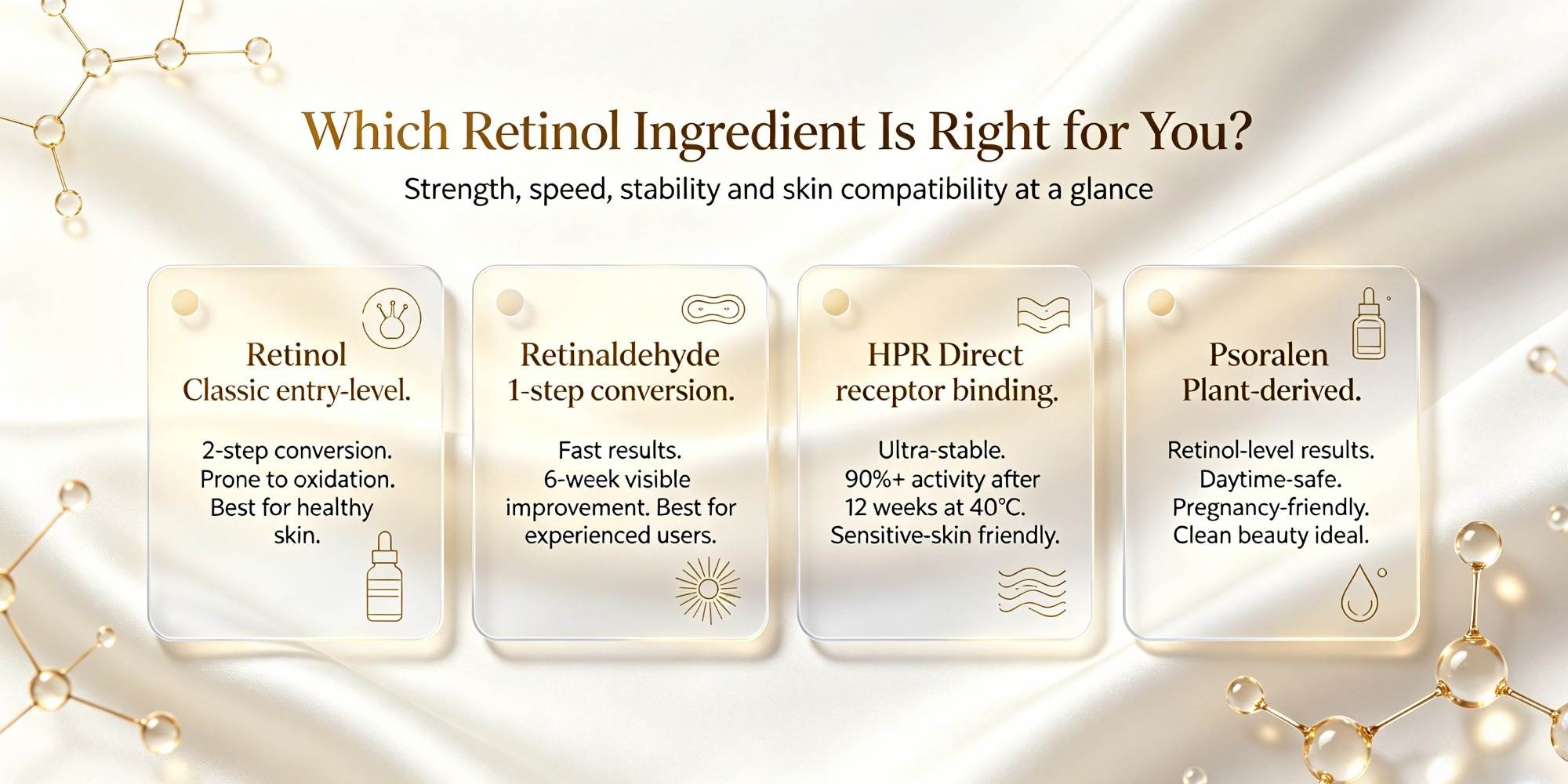
A quick guide in one table: how to choose between four types of retinol
| Dimensions of comparison | Retinol | Retinal | HPR (hydroxypinacolone retinoate) | psoralen |
| Speed of anti-ageing results | A gradual process requiring long-term commitment | Fast-acting | Intermediate | A slow start, but promising long-term results |
| Gentleness on the skin | Generally, may be poorly tolerated | Moderate; non-sustained-release; may cause irritation | Excellent, suitable for sensitive skin | Excellent; very little stinging or peeling |
| Composition Stability | Poor; prone to oxidation and failure | Generally speaking, there are certain storage requirements. | Excellent | Excellent, no risk of photosensitivity |
| Suitable for the following skin types | Healthy, resilient skin | Healthier, More Radiant Skin | Suitable for all skin types (including sensitive skin) | Suitable for all skin types; ideal for sensitive skin and during pregnancy |
Aisen Formula Combination Options
Drawing on its patented nano-encapsulation technology and a portfolio of over 3,000 market-proven, mature formulations, Aisen specifically addresses the formulation challenges associated with each type of ingredient:
1. Retinol / Retinaldehyde: Encapsulated in NLC (nanolipid) nanoparticles and liposomes to shield the active ingredients from light and oxygen, ensuring sustained release to minimise irritation and reduce peeling and redness. This approach powers our Microencapsulated Retinol Renewal Serum, which delivers high-potency anti-aging benefits with significantly reduced irritation. EU regulations stipulate that the maximum concentration of retinol-based ingredients in leave-on skincare products is 0.3 per cent, and formulations are developed in accordance with local compliance standards.
2. HPR (hydroxypinacolone retinoate): Combined with a nano-emulsion and a mild penetration-enhancing system, it improves transdermal absorption and enhances formulation stability;
3. Psoralen: Liposomes / nano-emulsions improve water dispersibility and absorption rates; combined with Centella asiatica for simultaneous anti-ageing and repair. For brands building a complete morning-and-evening routine, our Vitamin C12 Serum makes an ideal daytime companion—combining 12% pure vitamin C with salicylic acid for brightening and antioxidant protection.
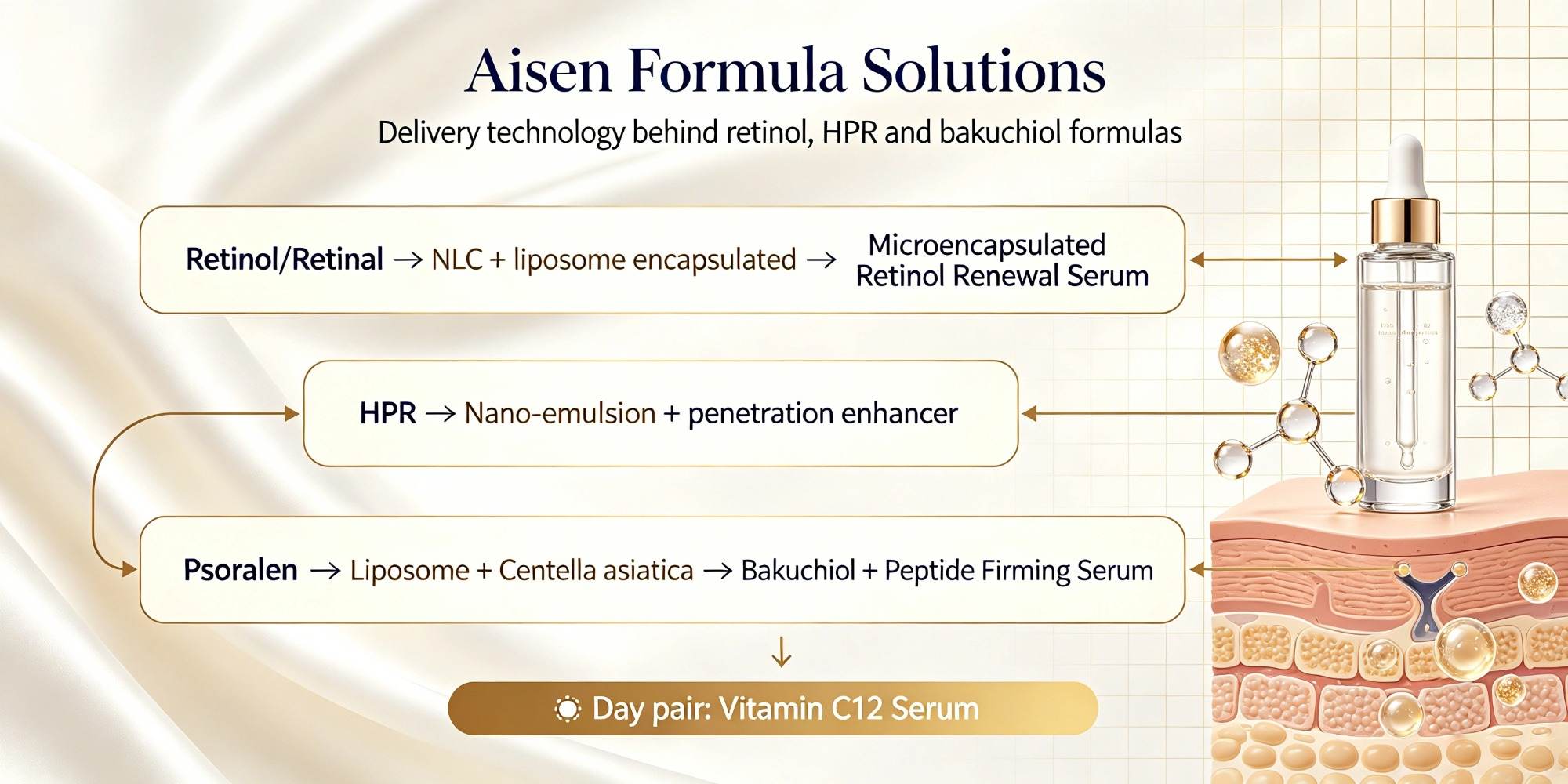
Rather than relying solely on high-concentration ingredients to enhance efficacy, we strike a balance between effectiveness, gentleness and long-lasting stability. Drawing on our proven delivery technologies and formulation expertise, Aisen develops anti-ageing skincare products tailored to all skin types worldwide.