Leave A Message
If you are interested in our products and want to know more details,please leave a message here,we will reply you as soon as we can.
submit
Custom Facial Skincare

private label skincare OEM

Home

private label skincare OEM

  • From 9.3% CAGR to Milk Exosomes: Why This Ingredient Is Becoming a New Opportunity in Repair Skincare
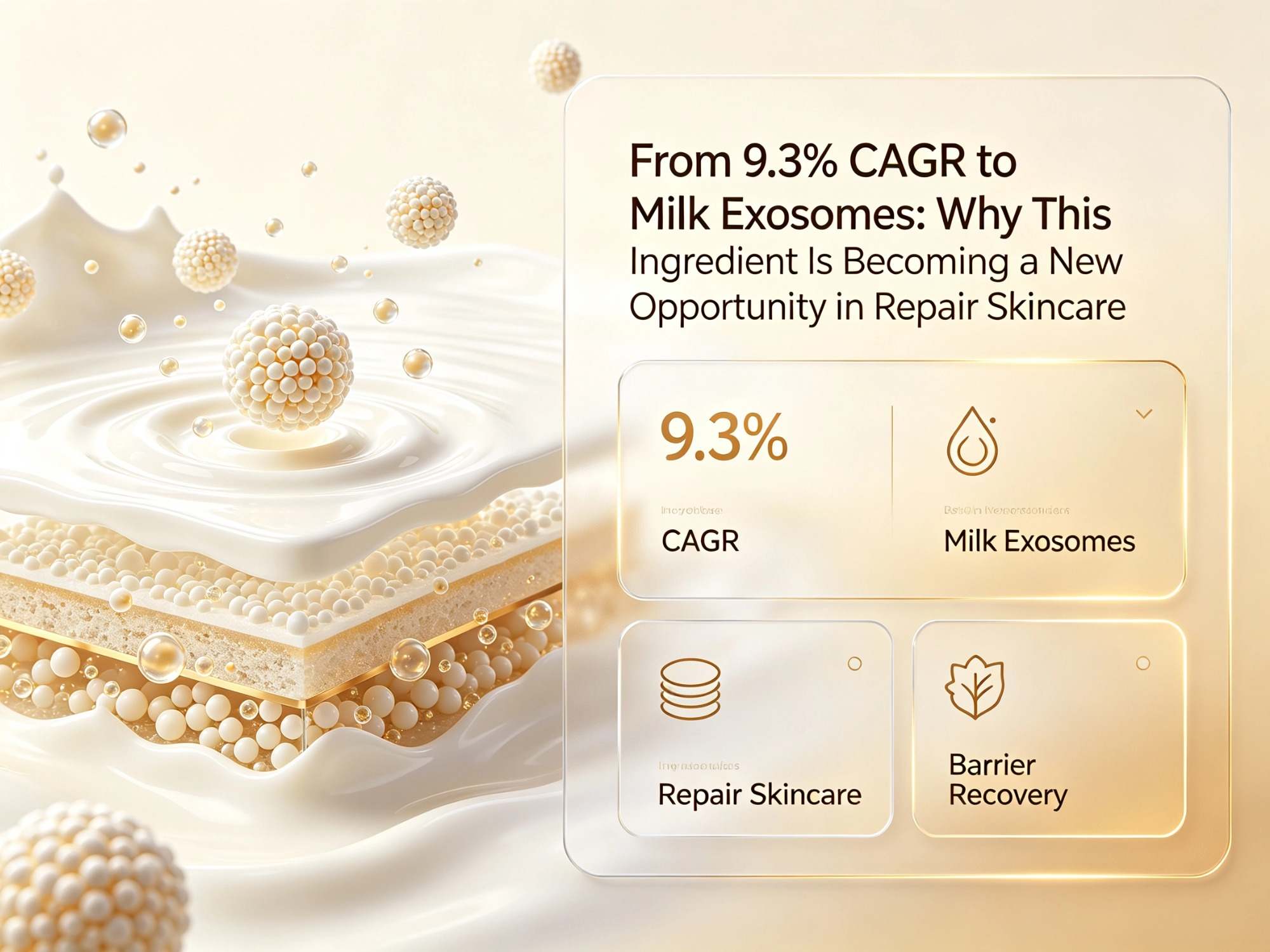
    From 9.3% CAGR to Milk Exosomes: Why This Ingredient Is Becoming a New Opportunity in Repair Skincare
    Jul 13, 2026
      According to Market.us, the global exosomes skincare market is projected to grow from USD 260.2 million in 2023 to USD 633.2 million by 2033, with an estimated CAGR of 9.3%. Another report from Coherent Market Insights estimates that the global exosomes skincare market will reach USD 460.0 million in 2026 and grow to USD 819.4 million by 2033, with a projected CAGR of 10.1%. These numbers show a clear direction: exosome skincare is no longer only a laboratory concept. It is entering brand development, functional skincare, professional care, and premium repair product competition. For global skincare brands, importers, cross-border e-commerce sellers, spa and salon channels, and private label customers, the real question is not only whether exosomes are trending. The better question is what kind of exosome concept is easier for consumers to understand, and what kind of exosome product can be developed into a sellable, export-ready, and repeat-order skincare solution. This is why milk exosomes are attracting more attention. For a skincare OEM/ODM factory like Aisen Pro Skin, exosomes are not only a concept for marketing traffic. They are also a product development direction that can be extended into serums, ampoules, creams, masks, and recovery skincare sets. Aisen already has a plant-derived active vesicles recovery serum solution and is also building product reserves around milk exosomes, allowing different customers to choose a more suitable exosome concept according to their market positioning.     1. Why Exosome Skincare Is Becoming a Hot Topic Over the past few years, many popular skincare ingredients have been concentrated in several familiar directions. Niacinamide is linked with brightening. Vitamin C is linked with antioxidant care and radiance. PDRN is linked with repair and elasticity stories. Peptides are linked with anti-aging and firming. Ceramides are linked with barrier care. As these ingredients become more mature, brands need new technology concepts to create differentiation. Exosomes fit this demand well because they can connect with advanced repair, barrier support, recovery-looking care, skin revitalizing, anti-aging support, sensitive skin comfort, and high-tech skincare positioning. The trend is also supported by a wider shift in consumer preference. Many customers are becoming more careful with aggressive products and are looking for formulas that feel advanced but still comfortable. Instead of only chasing a stronger exfoliating or whitening message, brands are increasingly building stories around barrier care, visible recovery, healthy-looking skin, glow, and long-term skin condition. This gives exosome concepts a stronger commercial role in repair skincare. However, brands need to be careful with cosmetic wording. Exosome skincare should not be described as a medical treatment. Claims such as cell repair, tissue regeneration, inflammation treatment, or wound healing should be avoided in cosmetic product communication. More suitable skincare language includes helping skin look healthier, smoother, more comfortable, more radiant, and better supported in barrier care.   2. Why Milk Exosomes Are Suitable for a Skincare Ingredient Story Milk exosomes, also called milk-derived exosomes or milk extracellular vesicles, are nano-sized extracellular vesicles naturally present in milk. Public research describes milk-derived exosomes as containing lipids, proteins, and microRNAs, and they are being studied in areas related to active delivery, skin barrier support, and comfort in skincare formulation science. Compared with some biotechnology ingredients that are difficult for consumers to understand, milk exosomes have one strong advantage: the source story is easier to remember. Milk naturally reminds consumers of nourishment, softness, comfort, nutrition, and premium repair. For brands, this source story is easier to translate into product pages, short videos, sales materials, and packaging concepts than a complex technical term alone. This also makes milk exosomes especially useful in content marketing. A brand can build an ingredient story around milk-derived technology, nano-vesicle care, nourishing repair, soft skin feel, and premium recovery skincare. For e-commerce and independent websites, this gives the product more search and storytelling angles than a basic moisturizing product. In repair-focused skincare, milk exosomes can naturally connect with dry and rough-looking skin, weak barrier feeling, seasonal sensitivity, post-treatment daily care concepts, fine lines, plumper-looking skin, dull and tired-looking complexion, reduced radiance, and premium spa care experiences.     3. Trend Analysis: Why Serums and Ampoules Are the Best First Step From a market perspective, exosome-related products are most suitable for serums and ampoules as the first development direction. Market.us reported that exosome serums accounted for about 33% of revenue share in the exosomes skincare market in 2023. Coherent Market Insights also projects that exosome serums will contribute the highest product-type share in 2026, at about 43.6%. This is not surprising. Serums already represent higher concentration, stronger efficacy positioning, and advanced active ingredients in the consumer mind. When a brand wants to introduce a new technology concept such as milk exosomes, a serum or ampoule gives the product a more natural premium position than a basic cleanser or toner. For B2B customers, this suggests a practical launch path. A startup brand can begin with a milk exosome repair serum. A spa channel can use an exosome ampoule as a professional-looking retail product. A premium brand can develop an exosome recovery cream or anti-aging repair set after the first serum gains recognition. Importers and wholesalers can also use serum-led launch logic to test demand before expanding into masks, creams, and sets. From a factory development perspective, Aisen tends to first apply exosome concepts to high-perception products such as serums, ampoules, and recovery creams. These categories make it easier to express the value of advanced active ingredients and help brands explain repair, barrier support, comfort, and radiance in product pages, independent-site content, and sales materials.     4. How Milk Exosomes Can Be Combined with Other Actives Milk exosomes should not be positioned as a single miracle ingredient. For products that need to be launched and sold, they should be combined with mature active ingredients to create a complete formula logic. This is also something Aisen pays close attention to in exosome product development. For B2B customers, exosomes can provide a high-tech ingredient story, but the real commercial value often depends on how they are combined with other proven skincare ingredients. A good exosome product should not only say contains exosomes. It should make it clear what skin concerns it targets, what usage scenario it fits, and why consumers should try it. Milk exosomes can be paired with ceramides for barrier support, hyaluronic acid for hydration and plumper-looking skin, peptides for anti-aging repair concepts, centella or panthenol for soothing care, PDRN for premium recovery and glow, or niacinamide for repair plus brightening. This formula logic makes the ingredient easier to translate into different product stories and price bands. For B2B customers, the real value is not only whether the formula contains milk exosomes. The value is whether the factory can develop them into a product with a clear formula logic, comfortable texture, complete selling points, supporting documents, and market-fit positioning.   5. Milk Exosomes Are Not Suitable for Every Brand Although milk exosomes have a strong premium repair story, they are not suitable for every brand. If a brand focuses on vegan, plant-based, 100% botanical, or strict plant-derived positioning, milk exosomes may not be the best fit. In some markets, customers may also need to consider animal-derived ingredient perception, dairy-source communication, allergen-related wording, halal requirements, label expression, and local regulatory expectations. This does not mean milk exosomes are a weakness. It means the source strategy should match the brand position. Therefore, when Aisen recommends exosome concepts to customers, it does not simply say that one source is always better. Instead, the team first considers the customer's target market, sales channel, brand positioning, and label requirements. If the customer wants to emphasize premium nourishment, milk-derived technology, and professional repair, milk exosomes can be a memorable direction. If the customer cares more about plant-derived skincare, clean beauty, or vegan storytelling, plant-derived active vesicles may be a better fit. This flexibility matters because the exosome trend is not one single formula route; it is a product concept platform that can be adapted to different markets.   6. How Aisen Helps Customers Develop Exosome Concept Products For many B2B customers, the challenge of exosome product development is not only finding a new ingredient. The harder part is turning the concept into a real product that can be sold. This requires source selection, formula combination, texture design, packaging, product documents, export files, and replenishment capability. Aisen Pro Skin already has a Next-Gen Exosome Technology Plant Peptide Recovery Serum solution, featuring plant-derived active vesicles, plant peptides, ceramides, and hyaluronic acid. It is suitable for barrier support, sensitive skin care, daily recovery, and private label development. At the same time, Aisen also has product reserves in the milk exosome direction and can further develop milk exosome serums, exosome ampoules, recovery creams, masks, or complete recovery sets according to customer needs. Aisen's advantage is not only offering a trending ingredient. The value is helping customers turn the exosome concept into a more complete OEM/ODM/OBM product solution. Customers can choose milk exosomes, plant-derived active vesicles, or combine exosome concepts with ceramides, hyaluronic acid, peptides, PDRN, centella, panthenol, and other ingredients to build clearer repair, barrier care, anti-aging, or post-care positioning. In production and delivery, Aisen has 3,000+ mature skincare formulas, 12 automated production lines, a 100,000-grade clean workshop, GMPC and ISO 22716 standards, and annual capacity of up to 80 million units. This allows Aisen to support global customers from sample development, small trial orders, and packaging selection to stable replenishment.     Conclusion: The Opportunity of Milk Exosomes Is Not Only That They Are New The exosome skincare market is growing, and consumers are paying more attention to high-tech repair, barrier support, sensitive skin care, and anti-aging recovery concepts. The value of milk exosomes is that they combine the advanced feeling of exosome technology with the nourishment, softness, and premium repair story of a milk-derived source. For B2B customers, however, the real opportunity is not only finding a new ingredient. It is finding a factory that can turn the ingredient into a mature skincare product. If you are developing a milk exosome serum, exosome ampoule, recovery cream, post-care skincare set, or private label exosome skincare line, share your target market, sales channel, source preference, packaging needs, and order quantity with Aisen. Aisen can recommend milk exosome, plant-derived active vesicle, or combined exosome OEM/ODM/OBM skincare solutions to help your brand turn a trending ingredient into a product better suited for global markets.   China Anti-Aging & Brightening Salmon PDRN Facial Serum Supplier | aisenproskin.com China Vitamin C12 Serum 12% Pure Vitamin C Salicylic Acid Supplier | aisenproskin.com  
    Read More

  • A New Blue Ocean for Clean Beauty: How Aisen Helps Brands Capture the Teen Skincare Market
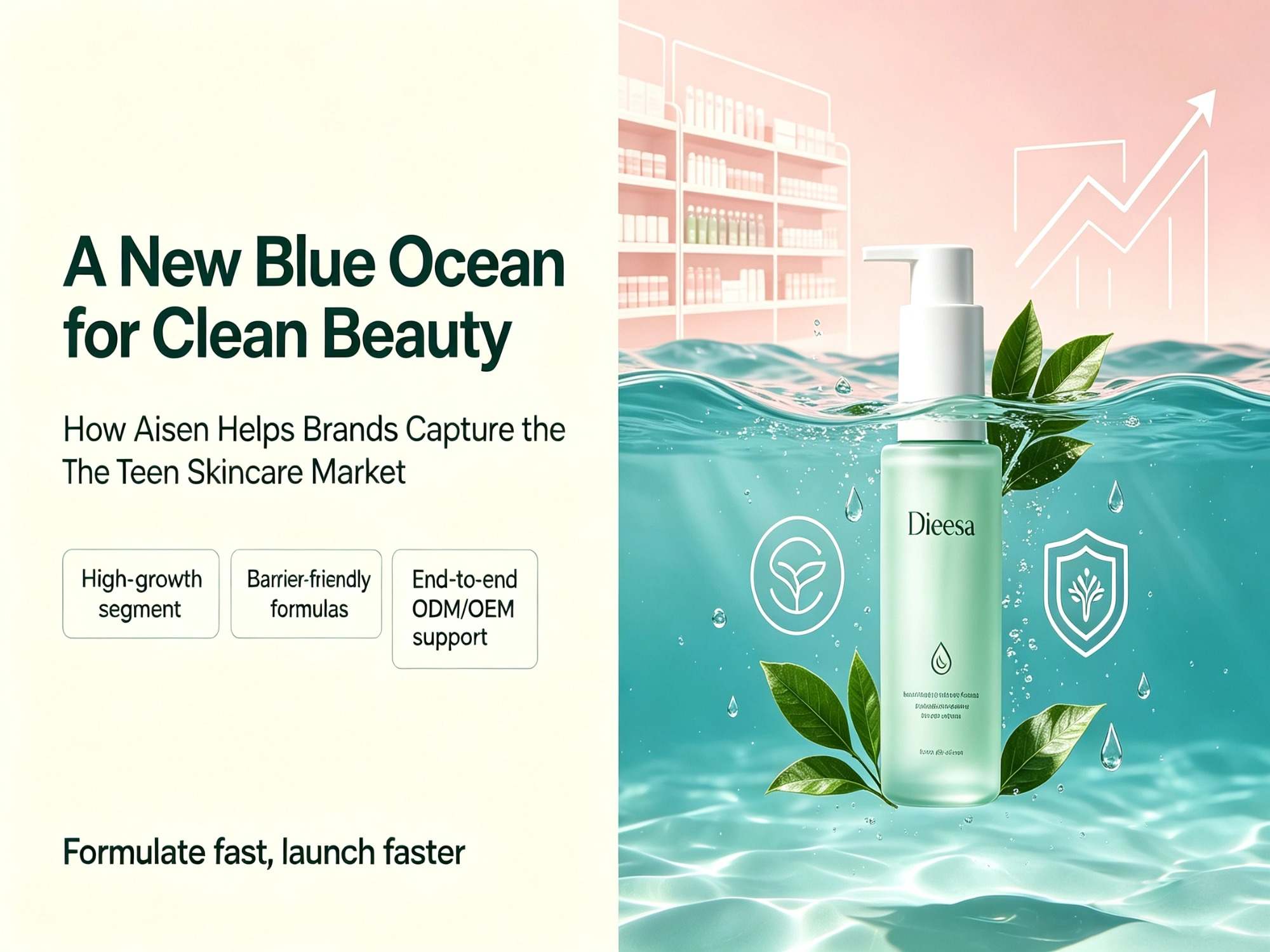
    A New Blue Ocean for Clean Beauty: How Aisen Helps Brands Capture the Teen Skincare Market
    Jul 06, 2026
      1. Market Opportunities: Natural Skincare for Young People Emerges as a Key Growth Driver in the European and American Beauty Markets Whilst competition in the adult clean beauty sector is becoming increasingly saturated, the teenage skincare segment is emerging at a rate far exceeding the industry average. According to Mordor Intelligence’s 2026 industry report, the global clean beauty market was valued at US$9.5 billion in 2025 and is projected to grow to US$24.8 billion by 2032, representing a compound annual growth rate (CAGR) of 14.7 per cent; within which the children’s and teenage skincare segment is projected to grow at a CAGR of 13.12 per cent. Data from Technavio indicates that the global teenage personal care market was valued at US$36.7 billion in 2024 and is forecast to reach US$47.5 billion by 2030; during the same period, the natural and organic personal care market is projected to reach US$23.54 billion in 2025 and is expected to exceed US$23.96 billion by 2032.   Social media has been the key catalyst for this wave of growth. The ‘Sephora Kids’ craze, fuelled by TikTok and Instagram, continues to gain momentum—with this trend still maintaining a year-on-year growth rate of 11.4 per cent in search queries in 2025. Research by Ulta Beauty shows that the average age at which Generation Alpha first tries beauty products is just 8 years old, far lower than the 15 years typical for Millennials. However, as large numbers of teenagers follow trends and use potent adult products such as retinol and high-concentration salicylic acid, concerns are being raised by dermatologists and parents alike—these ingredients may do more harm than good to young, developing skin. There is a severe imbalance between supply and demand in the market: on the one hand, there are children’s products with overly mild formulations; on the other, adult skincare containing potent active ingredients. Products catering to the ‘middle ground’—suitable for the oily, barrier-compromised skin typical of adolescence—are extremely scarce.     2. Three key growth drivers underpinning the sector’s long-term growth (1). Parents drive safe consumption, with pure formulations becoming a mandatory requirement. In Europe and the US, parents lead the decision-making process for family skincare purchases, with fragrance-free, alcohol-free, and preservative-free products—free from irritating preservatives and made with natural plant extracts—now serving as basic selection criteria. According to Piper Sandler’s Spring 2025 report, *Taking Stock With Teens*, annual beauty spending by teenagers reached US$374, representing a year-on-year increase of 10 per cent. Gen Z and Generation Alpha have adopted a ‘ingredients first, brand second’ approach to consumption—they prioritise checking the ingredients list when making purchases, with product transparency and mildness directly determining repurchase rates.   (2). There is a gap in the market, with a scarcity of products in the mid-range segment; current offerings are polarised: on the one hand, there are minimalist skincare products with limited efficacy, suitable only for very young children; on the other, there are adult skincare products targeting mature skin and containing potent active ingredients. The shortage of products with formulations specifically tailored to teenagers’ skin—which is characterised by excessive oil production, a fragile skin barrier, and a tendency towards redness and breakouts—presents an excellent window of opportunity for brands to enter the market.   (3). As the concept of clean beauty gains traction and demand for natural and organic products continues to expand, the global market for natural and organic personal care products is growing steadily, with clean skincare standards rapidly gaining ground amongst teenagers. Offline multi-brand stores in Europe and the US, cross-border e-commerce platforms and TikTok Shop have all introduced dedicated sections for teenage clean skincare, with channels proactively allocating resources to this segment; the conditions for commercialisation in this sector are now ripe.     3. International giants are leading the way, and the sector has officially entered a phase of mainstream competition   Sephora to exclusively launch the teen-focused, clean skincare brand ‘Sincerely Yours’ in September 2025, sending a key signal to the market (Official PR Newswire Release) PR Newswire: Developed by a father-daughter blogging duo in collaboration with dermatologists, the range comprises four core products (gentle cleanser, soothing mist, repair cream and mineral sunscreen), each priced under US$30 and all certified by Sephora Clean. are vegan, cruelty-free and free from comedogenic ingredients, whilst avoiding irritating anti-ageing acids. Instead, they combine sustained-release hyaluronic acid, ceramides and low-concentration niacinamide to repair the skin barrier. The range sold out within a single day at physical stores, and pop-up events attracted 87,000 teenagers. At the same time, Yes Day, a professional skincare brand targeting the 10–15-year-old Alpha Generation, was launched. Developed in collaboration between 13-year-olds and renowned cosmetic chemists, the products have undergone clinical dermatological testing and exclude highly irritating active ingredients, precisely tailored to the tolerance levels of adolescent skin. This move by Sephora sends a clear signal: clean skincare for teenagers has evolved from a niche demand into a mainstream category.     4. Aisen Formulation ODM/OEM Solutions: One-stop compliance with European and US standards As adolescents have active sebaceous glands and an immature skin barrier, the core philosophy behind the formulations is low irritation, gentle efficacy and powerful repair. Aisen can provide and customise four major product lines, all of which meet the compliance requirements for Clean Beauty certification in Europe and the US, as well as being vegan and cruelty-free: (1). The Pure Amino Acid Cleansing Range utilises APG and amino acid-based gentle surfactants. Free from soap bases, fragrances and alcohol, it is formulated with Centella asiatica and oat beta-glucan to soothe and reduce redness. It cleanses without disrupting the skin’s natural lipid barrier, making it suitable for oily, sensitive skin during adolescence.  (2). Lightweight Barrier Repair and Moisturising Range: Featuring refreshing textures such as gel and light lotion, enriched with panthenol, ceramides and low-molecular-weight hyaluronic acid. Designed to provide essential hydration and stabilise the skin without a heavy, suffocating feel, making it suitable for teenagers’ daily skincare routines. (3). Pure Physical Mineral Sunscreen Range: Featuring a physical sunscreen system comprising only zinc oxide and titanium dioxide, free from chemical sunscreen agents and fragrance-free to avoid irritation. Modeled on Sincerely Yours’ core best-sellers, this range is suitable for daily use at school and during commutes.  (4). Soothing and Repairing Cleansing Pads: Formulated with botanical soothing extracts and free from high-concentration acids, these pads provide both secondary cleansing and soothing in a single swipe, aligning with the popular format of quick skincare videos among teenagers.     5. Conclusion Clean skincare for teenagers in Europe and the US is not a short-lived trend, but rather a segment of the clean beauty market with assured growth potential. Leading retailers such as Sephora have already established their product ranges in this category, leaving only a limited window of opportunity in the market. Leveraging its mature formulation technology and experience in meeting overseas regulatory requirements, Aisen provides end-to-end ODM/OEM implementation services for cross-border brands, helping them rapidly capture the untapped market for teenage skincare with barrier-friendly, clean formulations.     Disclaimer: For B2B reference only. Aisen is an independent OEM/ODM manufacturer and not affiliated with any mentioned brands. Brand owners are responsible for ensuring local regulatory compliance.   Related Products China Natural Whitening Goat Milk Soap Bar Rose Carving Supplier | aisenproskin.com China Microencapsulated Retinol Renewal Serum Supplier | aisenproskin.com    
    Read More

  • Sephora’s 2026 Skincare Trends Analysis: How Aisen Helps Brands Seize the Initiative in the Global Luxury Skincare Market
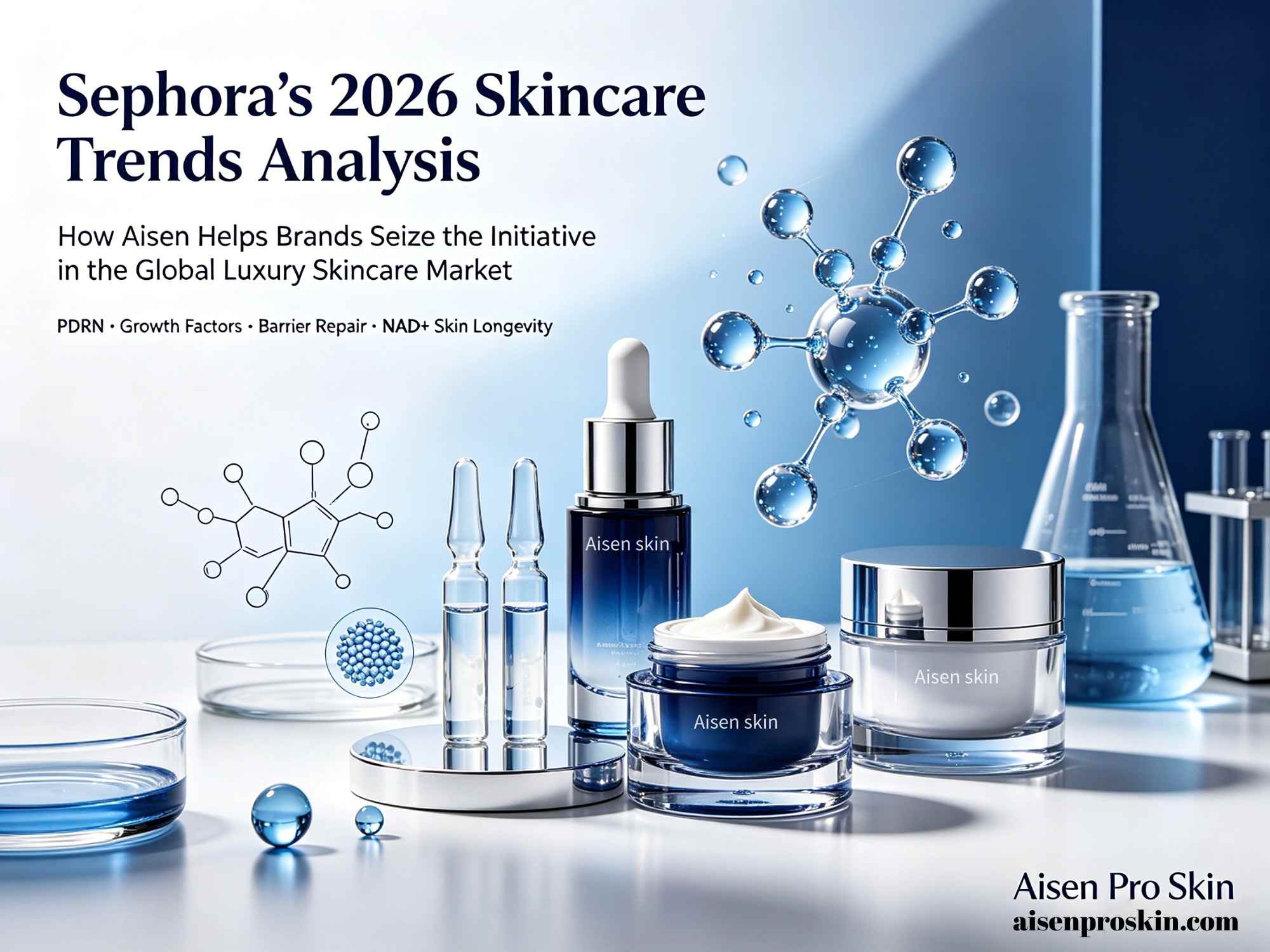
    Sephora’s 2026 Skincare Trends Analysis: How Aisen Helps Brands Seize the Initiative in the Global Luxury Skincare Market
    Jul 01, 2026
    In 2026, Sephora will redefine luxury skincare through three key pillars: barrier-first skincare, clinical-grade therapeutic products and sensory experiences. At the same time, Sephora announced a strategic partnership with Olive Young, set to launch dedicated K-beauty sections in six markets—including the US, Canada and Singapore—in the autumn of 2026. Medical-grade ingredients such as PDRN, growth factors and NAD+ are making the transition from specialist clinics to everyday skincare counters. The following analysis explores Aisen’s product development direction based on four key trends.   Trend 1: PDRN – From aesthetic clinics to Sephora’s shelves PDRN (poly-deoxyribonucleotide) is the fastest-growing ingredient in the skincare sector in 2026—with Google search volume surging by 510 per cent, year-on-year growth in the US market reaching 322.3 per cent, and the global market for PDRN repair ampoules projected to reach US$540 million by 2026 (CAGR 12.7 per cent).   This trend has now taken Sephora by storm: Anua’s PDRN serum, Rejuran’s Turnover Ampoule (containing 0.5% c-PDRN, $52) and Dual Effect Ampoule (c-PDRN + Ceramide NP, $55) are now available in approximately 380 Sephora stores; Medicube’s PDRN Pink Peptide Ampoule has been introduced to Sephora stores across Europe; innisfree and IOPE have also successively launched their own PDRN product ranges. PDRN first gained popularity in the medical aesthetics sector as the ‘salmon injection’; its core value lies in triggering the skin’s own repair pathways, supporting cell renewal and strengthening the skin barrier.   Product categories offered by Aisen: 1. PDRN Barrier Repair Ampoule: PDRN + 5-fold ceramides + Centella asiatica; liposome encapsulation technology enhances transdermal absorption 2. PDRN Soothing & Repairing Pads: Contains vegan PDRN, combining toner, serum and gentle exfoliation in one product 3. PDRN + NAD+ Cellular Energy Serum: A blend of PDRN and NAD+ for dual synergistic effects of repair and energy metabolism     Trend 2: Growth Factors – The Next Generation of Anti-Ageing Growth factors are at the forefront of anti-ageing in 2026. Sephora has launched the Biossance Squalane + Growth Factor Firming Moisturiser (priced at AUD 98), which utilises growth factor technology that mimics the signalling mechanisms of youthful skin to help improve skin laxity, elasticity and fine lines. The product is vegan, cruelty-free and has been awarded Sephora’s Clean Beauty certification. These ingredients act directly at the cellular level to promote collagen production and are regarded as the next generation of anti-ageing solutions.   Product categories offered by Aisen: 1. Growth Factor Firming Face Cream: Centred around a growth factor complex and formulated with squalane and peptides, this product is positioned as a premium anti-ageing face cream. Aisenko utilises a nano-emulsion delivery system to enhance the stability and transdermal absorption of the growth factors.   2. Growth Factor Repair Serum: Development of a repair serum containing a blend of growth factors and peptides, targeting consumers seeking cutting-edge technology.     Trend 3: Barrier Repair – ‘Barrier First’ from Face to Body Barrier repair is one of Sephora’s key skincare themes for 2026. The A-CICA365 range from South Korean brand Aestura has joined the Sephora line-up, focusing on soothing irritation and supporting the damaged skin barrier. British brand BYOMA has launched at Sephora Canada with its ‘barrier-first’ philosophy. Barrier repair is rapidly expanding from facial care to body care.   Product categories offered by Aisen: 1. Centella Asiatica Barrier Repair Cream: Formulated with Centella Asiatica extract at its core, this cream is enriched with a blend of five types of ceramides, cholesterol and fatty acids, mimicking the skin’s natural lipid ratio to deliver a dual-action approach of ‘anti-inflammation and physical barrier repair’.   2. Ceramide Bio-Mimetic Repair Range: A comprehensive range of barrier-repair products, including face creams, serums and body lotions, utilising a ceramide complex with a lipid ratio identical to that of the human stratum corneum to precisely repair barrier damage.     Trend 4: Skin Longevity – From ‘Anti-Ageing’ to ‘Cell-Level Anti-Ageing’ The industry is shifting from traditional ‘anti-ageing’ towards skin longevity. Paula’s Choice CellularYouth Longevity Serum is now available at Sephora (exclusively at Sephora from 22 January 2026); this product utilises NAD+ support technology to maintain the skin’s natural energy cycle, improving skin laxity and complexion. NAD+ is a key molecule in cellular energy production and repair, and supporting NAD+ levels has become an interdisciplinary field at the intersection of longevity science and skincare innovation. By slowing down skin ageing at the cellular energy metabolism level, ingredients of this kind represent the next frontier in anti-ageing.   Product categories offered by Aisen: 1. NAD+ Skin Longevity Serum: Centred on NAD+, this formula combines nicotinamide riboside (NR, a precursor to NAD+) and PDRN to delay skin ageing at the level of cellular energy metabolism.   2. Cellular Energy Repair Cream: Combining NAD+ with growth factors and peptides, this product is positioned as a ‘cellular-level anti-ageing’ solution, targeting high-end consumers seeking cutting-edge technology.     How does Aisen help brands capitalise on Sephora trends? Four major trends—PDRN, growth factors, barrier repair and skin longevity—all point in the same direction: consumers are no longer seeking merely superficial enhancements, but measurable, biologically driven skincare results.   Relying on its patented nano-encapsulation technology and a library of over 3,000 proven formulations, Aisen offers brands four key product categories: PDRN Range: Ampoule Serums, Repairing Pads, Repairing Creams; available in both vegan and animal-derived PDRN variants Growth Factor Range: Firming Creams, Repairing Serums; stability ensured by a nano-emulsion delivery system Barrier Repair Range: Centella Asiatica Cream, Ceramide-inspired products, Repairing Pads   NAD+ Range: Cellular Energy Serum, Longevity Cream, targeting the high-end anti-ageing market In 2026, competition in the premium skincare sector has shifted from a ‘race for ingredient concentration’ to a contest over ‘who can be the first to deliver medical-grade ingredients to consumers in stable, highly effective formulations’. Sephora’s shelves are sending a clear signal—PDRN, growth factors and NAD+ are the next battleground. Aisen is committed to helping brands seize the initiative with its proven delivery technologies and formulation expertise. Disclaimer: This article is for B2B industry reference only. All brand names mentioned are trademarks of their respective owners and are cited solely for trend analysis. Aisen is not affiliated with or endorsed by any of these brands. Product categories listed are development directions and do not represent currently available stock formulations. Brand owners are responsible for ensuring compliance with local regulations in their target markets.   Related products: China Anti-Aging & Brightening Salmon PDRN Facial Serum Supplier | aisenproskin.com China Korean Blue Copper Peptide Brightening Toner Serum Set Supplier | aisenproskin.com China Brightening Body Lotion 72h Hydration Non Greasy Supplier | aisenproskin.com Related articles:Stabilizing Skincare Actives: Liposomes, NLCs & Cyclodextrins-www.aisenproskin.com  
    Read More

leave a message

leave a message
If you are interested in our products and want to know more details,please leave a message here,we will reply you as soon as we can.
submit

home

products

WhatsApp

CONTACT US

Start a Conversation

Hi! Click one of our members below to chat on